Töö is a lovely Estonian word which has a phonetic representation that somehow perfectly reflects its semantic meaning of "work." Some of you wonder if I really do any töö between taking pictures of the snow and socializing. For those that are interested in this other side of my life, the one that leads to international travel and intercultural dialogues -- the one that I find fascinating, challenging, intriguing, and sometimes controversial, I share with you the following links for you to navigate and test your Estonian skills:
University of Tartu Newspaper article about internationalization and English language support for faculty and staff (in Estonian)
The crux of my 8-5 (yeah, right!) and spring course offerings at UT
Any brilliant ideas, comments, suggestions, or ready-made curricula/syllabi/lesson plans are welcomed!
Showing posts with label english language fellow. Show all posts
Showing posts with label english language fellow. Show all posts
Tuesday, January 30, 2007


Sunday, January 07, 2007
Jõule Highlights


Everyone knows that there is no place like home for the holidays, but, unfortunately, I wasn't able to go home this year. So, I gathered a few fellow vagabonds -- friends old and new -- and we infused the season with cheer (or rather stuffed it with abundant amounts of tasty homemade morsels). Here are a few of the highlights or our Jõule (Christmas) celebrations!

Gathering on Christmas Eve, we were lucky to have in our midst a world-renowned German MPP (Master Potato Peeler), Hape.
 Traveling all the way from Finland, we also had master Chef Jen, pictured right, preparing scrumptious dishes of her home tradition -- cranberry bread, special kind of scalloped potato with sardines that I forget the name of, almond paste coffee bread, meatballs (and the chef is vegetarian... imagine that!) to name a few of the tasty items.
 We also had a dancing Russian, Nastya, who prepared her potato salad and blini with much flare and then persuaded us all to join her in a hilarious game of charades/pictionary.
Caroline, a carrot-peeling Nebraskan (who also makes a mean batch of maraschino cherry cookies, by the way) brought many smiles and cheer to our bunch.

Finally, we were lucky to have two elves with us to prepare the salad and add to our lovely Christmas mix. Britta added some traditional German Christmas butter cookies to our table and Marika, the Estonian-Russian in our company, celebrated her first Christmas with our international crowd.
We celebrated both Christmas Eve and Christmas Day and filled our time with festivity:
Feasting on fabulous dishes... Trimming the tree with popcorn and cranberries... Playing games... Enjoying hot mulled wine... Laughing...
Watching movies... Sharing stories... Singing... Exchanging Presents...

Celebrating Birthdays...
(Hape birthday, Hape! ~ December 25 and Happy Birthday, Jen! ~December 26)


In the end, a very cozy and beautiful Christmas... I hope yours was as beautiful!

HÄID JÕULE, EVERYONE!
The Identity Question
It seems that every time I move to a new place there is a moment when culture shock taps me on the shoulder, catching me by surprise. Somehow, I keep assuming that, as a result of traveling so much and encountering so much "other," that I will reach a point where I am no longer affected. Last year in Romania, the question of identity consumed me. Perhaps because it was a transitional year between graduate school and the ever-looming "life" to follow or perhaps because it is normal to reconsider who you are and where you are going now and then, I felt as if the questions had an inescapable grip on me and demanded some serious brooding if not concrete answering:
Who am I? Am I like these ones or those ones? Where am I? Where am I going? What in the world am I doing? Do I want to be doing it? Do I like doing it? Who are these people with whom I've surrounded myself? Why? Why? Why? Why?
Ah, yes! These are the contemplative questions that reach me during culture shock and that beg me to stop and mull them over a bit in the new year... Estonia is no different.

My attitude towards travel and learning about language and culture (personally, not as a language teacher -- although that is undoubtedly affected) has really changed since my first explorations. I can remember the enthusiasm I had about learning about Slovakia, Slovak culture, and studying the language (este rozpravam po slovensky bez velkych problemov!). My first taste of being in a new place and exploring a tiny village and its life as well as my own place within it was fascinating and my attitude towards engaging it was incredibly intense and directed. Since living and traveling in a few other places, my dedicated spirit towards learning less-commonly spoken languages has waned. It's a question of time and it's a true question of investment. I would like to learn all things Estonian, including the fascinating language, but I am not exactly sure if the return on the investment is worth it. Beyond this short epoch of my life, does speaking and knowing Estonian make sense? Not that I shouldn't aim towards understanding and participating in the host culture, but, here in Tartu, I can do that pretty fully with English. It's a tough question. One that raises guilt in my consciousness. After all, I am a language teacher. Should I enjoy learning language just for the sake of doing so? Isn't it crass of me to try to quantify an outcome?
Hmmmm... I have been taking an Estonian class and have made some progress. I have tried to make Estonian friends, but this isn't easy in a culture that is largely quiet and a bit reticent until you are a known quantity. My circle of friends is more international than Estonian, but I excuse this with understanding that many Estonians have many more social obligations than I do at this moment and knowing that, together with these other international explorers, we can act as co-motivators in discovering and learning about this really interesting "Nordic Baltic country."
As proof of shifting identity, I offer pictures from our office Christmas party here in Tartu. The theme of this year's party was sailing, and I went in costume with two other women from my office (pictured above and also below with a sailor we also picked up from the office!). We wore Estonian national costumes and went as "Ranna-piiga," or the young women who await sailors when they come back to port. Somehow symbolic of my acceptance at work and in this place, I felt at home dressed up in this traditional garb for the evening. Perhaps if the wool skirt fits...?

I gave a presentation this week on culture, identity, and language teaching that got me thinking about shifting identities of language learners (and aimless wanderers like me). The literature seems to offer some real pearls of wisdom relating to this topic. I realize it is probably nerdy to use in-text quotations in a personal blog, but I guess I can embrace this geekiness as part of who I am!
Who am I? Am I like these ones or those ones? Where am I? Where am I going? What in the world am I doing? Do I want to be doing it? Do I like doing it? Who are these people with whom I've surrounded myself? Why? Why? Why? Why?
Ah, yes! These are the contemplative questions that reach me during culture shock and that beg me to stop and mull them over a bit in the new year... Estonia is no different.

My attitude towards travel and learning about language and culture (personally, not as a language teacher -- although that is undoubtedly affected) has really changed since my first explorations. I can remember the enthusiasm I had about learning about Slovakia, Slovak culture, and studying the language (este rozpravam po slovensky bez velkych problemov!). My first taste of being in a new place and exploring a tiny village and its life as well as my own place within it was fascinating and my attitude towards engaging it was incredibly intense and directed. Since living and traveling in a few other places, my dedicated spirit towards learning less-commonly spoken languages has waned. It's a question of time and it's a true question of investment. I would like to learn all things Estonian, including the fascinating language, but I am not exactly sure if the return on the investment is worth it. Beyond this short epoch of my life, does speaking and knowing Estonian make sense? Not that I shouldn't aim towards understanding and participating in the host culture, but, here in Tartu, I can do that pretty fully with English. It's a tough question. One that raises guilt in my consciousness. After all, I am a language teacher. Should I enjoy learning language just for the sake of doing so? Isn't it crass of me to try to quantify an outcome?
Hmmmm... I have been taking an Estonian class and have made some progress. I have tried to make Estonian friends, but this isn't easy in a culture that is largely quiet and a bit reticent until you are a known quantity. My circle of friends is more international than Estonian, but I excuse this with understanding that many Estonians have many more social obligations than I do at this moment and knowing that, together with these other international explorers, we can act as co-motivators in discovering and learning about this really interesting "Nordic Baltic country."
As proof of shifting identity, I offer pictures from our office Christmas party here in Tartu. The theme of this year's party was sailing, and I went in costume with two other women from my office (pictured above and also below with a sailor we also picked up from the office!). We wore Estonian national costumes and went as "Ranna-piiga," or the young women who await sailors when they come back to port. Somehow symbolic of my acceptance at work and in this place, I felt at home dressed up in this traditional garb for the evening. Perhaps if the wool skirt fits...?

I gave a presentation this week on culture, identity, and language teaching that got me thinking about shifting identities of language learners (and aimless wanderers like me). The literature seems to offer some real pearls of wisdom relating to this topic. I realize it is probably nerdy to use in-text quotations in a personal blog, but I guess I can embrace this geekiness as part of who I am!
“We cannot fully understand one culture in absence of contact with other cultures” (Savignon and Sysoyev, 2002: 510)
“The intentional acquisition of a new linguistic identity can result in a huge shift of the language learner’s understanding and interpretation of the world around him” (Marx, 2002: 264).
Identity is a project and a projection of self in constant fluctuation (van Lier, 2004).
Identity is a project and a projection of self in constant fluctuation (van Lier, 2004).
“Cultural contact implies that we perceive aspects, behaviors, values, and so on that are different than our own cultural background and thus provoke a rethinking of existing cultural categories” (Finkbeiner and Koplin, 2002: 4).
The notion presupposes that when language learners speak, they are not only exchanging information with the target language speakers but they are constantly organizing and reorganizing a sense of who they are and how they relate to the social world. Thus an investment in the target language is also an investment in a learner’s own social identity, an identity which is constantly changing across time and space (Norton Peirce, 1995: 17-18).
Finkbeiner, C., & Koplin, C. (2002). A cooperative approach for facilitating intercultural
education. Reading Online, 6. Available online:
http://www.readingonline.org/newliteracies/lit_index.asp?HREF=finkbeiner/index.
education. Reading Online, 6. Available online:
http://www.readingonline.org/newliteracies/lit_index.asp?HREF=finkbeiner/index.
Marx, N. (2002). Never quite a ‘native speaker’: Accent and identity in the L2 – and the L1.
The Canadian Modern Language Review, 59, 264-281.
The Canadian Modern Language Review, 59, 264-281.
Norton Peirce, B. (1995). Social identity, investment, and language learning. TESOL
Quarterly, 29, 9-31.
Quarterly, 29, 9-31.
Savignon, S. J., & Sysoyev, P. V. (2002). Sociocultural strategies for a dialogue of cultures.
The Modern Language Journal, 86, 508-524.
The Modern Language Journal, 86, 508-524.
van Lier, L. (2004). The ecology and semiotics of language learning. A sociocultural Boston
Friday, December 15, 2006
Impressions from way out east
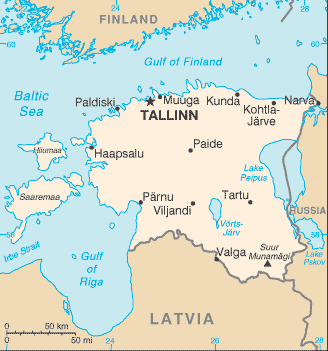
Last week, I traveled to Narva, a town situated on the very edge of Estonia where this city meets with the Russian border. Mentioning my travels, even to Estonians within their own rather geographically small country, garners a few appreciative inquiries and a whole slew of stereotypes. A predominately Russian town (90%) technically within the borders of Estonia, the town is known for its different character, industry, economic problems, and Russophone environment. A sceptic for all generalizations about places and people, I was prepared to defy the opinions of those who gave me a verbal preview of what I might find there. Listed below are a few things that I found.

1) Russian is, in fact, the de-facto lingua franca of Narva. Upon arrival by bus, I became suddenly aware of this difference when I asked for directions in Estonia and was met with a quizzical "ja nepanemayo" in Russian before trying out my own skills in Russian (quite conveniently, there is a lot of transfer from Slovak, the Slavic language I speak).

2) Towering over the river next to the city is the 14th-century Narva Castle. Although originally built by Danes, it has also had Swedish and Russian ownership. Now, in true Estonian style, there is Wi-Fi in the courtyard and a juxtaposition of cultures as Narva's statue of Lenin is also here.
One of the best views of the castle and Ivangorod Castle on the Russian side is from a Swedish lion gifted to the city.

3) English teachers here are friendly and excited about teaching! I spent four hours with teachers-in-training at Narva College (a branch of the University of Tartu where I normally teach) and a couple of hours at the American Corner at the Narva library working with local English teachers. They were approachable, fun, and quite creative as we spoke about language, culture, and pedagogy.

4) Bohemian life is also a piece of Narva's cultural landscape. For the two years prior to my arrival, there was an ELF (English Language Fellow) located in Narva, Kim. As chance would have it, Kim and I just happened to be colleagues at graduate school in Monterey and are still in contact with one another. While preparing for my trip, I asked for some advice about the area and Kim kindly put me in touch with some of her friends. We went out to a bar called Modern that was seemingly non-descript from the outside (you would never find it if you didn't know it was there). Truly Bohemian, the marker for the bar is a picture of the familiar Czechoslovak character, the Good Soldier Švejk. Apparently Svejk also mentioned Narva at some moment, and a plaque showcasing this quotation along with a picture of Svejk is tacked outside beside an lit advertisement for Czech beer. Needless to say, I felt quite at home in this artsy cellar drinking beer and philosophizing with Kim's friends.

Wednesday, December 06, 2006
Minu Jõulupuu

It's getting rather dark and gloomy outside as daylight truly dwindles. Last weekend was the "official" opening of the Advent season though and, suddenly, lights have appeared everywhere, somehow making it easier to cope with the dreariness of a December without snow. My home was no exception and I put up my Christmas tree this weekend! I take all of the flak for an artificial tree; it's a first for me and my preference, of course, would be to have the authentic spruce-scented article in my living room. However, the sparsely decorated item (more decor to come as I plan to hand-make some ornaments as time slows and the season nears a bit) really brings a lot of light to my living room. I can spend hours in the cozy darkness -- the advantage here is that it is dark more than light this time of year in Estonia -- contemplating the season.
P.S. Isn't jõulupuu a lovely way to say Christmas tree?
Anniversaries, Traditions, and Torches
 This past Friday was the 87th anniversary of the University of Tartu as an Estonian Institution. Full of tradition and celebration, the university shut down at noon to commemorate. The president of Estonia visited... there was song... there was torch carrying and processions... there was dancing. Unfortunately, I did not attend it all (or understand it all probably), but I did enjoy parts and managed to snap a few photos of some of the highlights. Here are pictures of the torch-carrying ceremony on Friday when fraternities, university staff, and local businesses processed through town to the university main building where they were met with greetings by the university rector. An impressive site, as you can appreciate, even from my shoddy photography!
 Another part of the festivities included an anniversary ball, the Tartu Ülikooli Aastapäevaball. Unlike formal dances in the States, this one included fancy dress AND formal dancing with the dance card printed for all to preview ahead of time. Highlights included live orchestral music, a performance by a well-known choral sextet, fireworks, cake and cognac, and of course the spectacle of everyone out for an evening of fun and dancing. I was no exception and enjoyed getting gussied up and breaking out my dancing shoes. My spirit did get caught up in the fantasy of the event; smiles didn't leave me the entire evening. It will remain a great memory of my time so far here in Tartu. Apparently, the event has been captured by others better than by me, so perhaps pictures will be forthcoming. The community of Tartu is rather small and everyone seems to be aware that I appeared at the ball (bit of a Cinderella story, no?) -- apparently some of images, hopefully flattering, of me dancing were captured by the local TV station and aired the other night!
Sunday, November 26, 2006
Receptacle for emotions
- The artist is a receptacle for emotions that come from all over the place: from the sky, from the earth, from a scrap of paper, from a passing shape... Pablo Picasso
Monday, November 06, 2006
As an English teacher you need to be practically perfect, eh?
Perfection is over-rated, even for English teachers.
Some readers of this blog really absorb each and every word that I write, hanging onto every word, analysing every sentence, noticing misusages, comma splices, and the horribly offensive typos that creep into my writing once in a while. It has been noted that occasionally (or perhaps frequently, depending on your perspective) my postings include some infelicities. I once misspelled waist as waste (!), I've been known to replace they're with their (!!), in the last posting I spelled teachers without the "r" (!!!). You can stop reading now if you've found this news difficult to swallow and are too shocked to continue. You may consider discontinuing your readership of this blog! For the brave, my confession continues...
Shame on me! ... and I call myself an English teacher! You could fault my training. You could blame me for being inattentive to language or just downright deft. You could also just call me human. I get so excited to have a free minute in which to share a thought or two that sometimes I get distracted by the message. I don't always painstakingly proofread my postings as I might for a handout or an article. My friends and family know that I sometimes write with my "hair on fire" and stream-of-conscious is a bit more natural to me in a blog than other forms of writing. After all, a blog is literally a web log or type of journal for jotting down observations and notes, right? Not that I don't care about spelling and correct usage, but everyone needs a place to let their hair down, right? (Yes, there is a pronoun agreement problem in the last sentence, but I am fairly unconcerned.) I know that my friends and family will forgive me and not let it shed bad light upon my character. We all need a little bit of grace.
Someone recently pointed out some language-related issues in my blogging. The comment was as follows:
It is fascinating that this antiquated notion of the flawless English grammarian continues to be a persuasive model for what language teachers do and the kind of character they have. Language is not a thing to be captured and molded; rather language is a tool molded by its users for a purpose, generally communication. Rules and regulations about right and wrong (even if they are petty typos or spelling errors) fall short of explaining the reasons of why language evolves and operates as it does.
That said, my purpose for making this posting is to invite those of you who have issues with my language use to consider whether or not you have understood the message. Make a joke about my errors (I do!). Enjoy them! Use them as an affirmation that your mistakes are a common part of the human condition. Before you seek to chastise me with comments or give me advice on editing, please remind yourself that blogging is for fun. I have taken off my professional hat in this setting. I do far too much professional and academic writing during the day to be worried about being reprimanded for a missing letter in a word that you understood correctly the first time anyway.
Thank you for listening to my diatribe; I hope that I have not steered you in the wrong linguistic direction with any errors as I have not followed the advice of carefully proofing this message. After all, I guess if I misspell one word for every thousand or so here, I consider that to be a pretty good ratio of accuracy to mistake!
**This message was approved by Jennifer Uhler, occasional bad speller despite the fact her mother made her write her mistakes in her spelling words 100 times when she was a child and even though she is now an English language teacher. The reader should be warned that I did not save this as a draft or read it slowly word-by-word to find typos and missing words.
Some readers of this blog really absorb each and every word that I write, hanging onto every word, analysing every sentence, noticing misusages, comma splices, and the horribly offensive typos that creep into my writing once in a while. It has been noted that occasionally (or perhaps frequently, depending on your perspective) my postings include some infelicities. I once misspelled waist as waste (!), I've been known to replace they're with their (!!), in the last posting I spelled teachers without the "r" (!!!). You can stop reading now if you've found this news difficult to swallow and are too shocked to continue. You may consider discontinuing your readership of this blog! For the brave, my confession continues...
Shame on me! ... and I call myself an English teacher! You could fault my training. You could blame me for being inattentive to language or just downright deft. You could also just call me human. I get so excited to have a free minute in which to share a thought or two that sometimes I get distracted by the message. I don't always painstakingly proofread my postings as I might for a handout or an article. My friends and family know that I sometimes write with my "hair on fire" and stream-of-conscious is a bit more natural to me in a blog than other forms of writing. After all, a blog is literally a web log or type of journal for jotting down observations and notes, right? Not that I don't care about spelling and correct usage, but everyone needs a place to let their hair down, right? (Yes, there is a pronoun agreement problem in the last sentence, but I am fairly unconcerned.) I know that my friends and family will forgive me and not let it shed bad light upon my character. We all need a little bit of grace.
Someone recently pointed out some language-related issues in my blogging. The comment was as follows:
"As an English teacher you need to be practically perfect, eh?"I beg to differ. I know how to analyze my audience and having a typo or two probably does not interrupt the message or offend the readership of this blog ostensibly. Secondly, I never aim to present myself as a perfect language user to my students. I do like language. I do like grammar. However, my goal as a teacher is not to present myself as something that I am not. I make mistakes sometimes. All language users -- in writing and speech -- sometimes do. Almost all human beings do at some point or another. It's okay. The interesting part of being a language teacher is presenting language and everything that it is, including a few infelicities, in such a way that students can access and become more aware about how it works. It is a brilliantly challenging job. As many of you know, my work pervades my outside life and a day rarely passes that I don't tuck something away for my students or future language work. Any language is complex, even English.
It is fascinating that this antiquated notion of the flawless English grammarian continues to be a persuasive model for what language teachers do and the kind of character they have. Language is not a thing to be captured and molded; rather language is a tool molded by its users for a purpose, generally communication. Rules and regulations about right and wrong (even if they are petty typos or spelling errors) fall short of explaining the reasons of why language evolves and operates as it does.
That said, my purpose for making this posting is to invite those of you who have issues with my language use to consider whether or not you have understood the message. Make a joke about my errors (I do!). Enjoy them! Use them as an affirmation that your mistakes are a common part of the human condition. Before you seek to chastise me with comments or give me advice on editing, please remind yourself that blogging is for fun. I have taken off my professional hat in this setting. I do far too much professional and academic writing during the day to be worried about being reprimanded for a missing letter in a word that you understood correctly the first time anyway.
Thank you for listening to my diatribe; I hope that I have not steered you in the wrong linguistic direction with any errors as I have not followed the advice of carefully proofing this message. After all, I guess if I misspell one word for every thousand or so here, I consider that to be a pretty good ratio of accuracy to mistake!
**This message was approved by Jennifer Uhler, occasional bad speller despite the fact her mother made her write her mistakes in her spelling words 100 times when she was a child and even though she is now an English language teacher. The reader should be warned that I did not save this as a draft or read it slowly word-by-word to find typos and missing words.
Sunday, November 05, 2006
beyond the weather
Now that I have warmed up with a short discussion of the weather, I suppose that a few updates are in order. I feel as if a million things have passed in the last weeks and I haven't had time to share. Here are some new developments (beyond the weather) in Tartu:
English teachers are cool. They really are. Perhaps teachers are cool in general, but I can't speak from that perspective as accurately. This weekend, I attended a conference for the Estonian Association of Teachers of English (EATE) and met many language teachers from the area. There were some good speakers at the conference, many of them from abroad, but the real highlight was meeting participants. I have felt a little bit professionally isolated since my arrival, especially since I am sponsored by and situated within an administrative university unit rather than a faculty. Having conversations about teaching and language was just the confirmation and energy boost I needed about my vocation. Woo-hoo!!!
I've joined a cross-country skiing training group at the ski club here in Tartu. The group is for adult beginners and meets twice a week to exercise. Last year, several members of this beginning group later participated in the Tartu Maraton in mid-February. Estonia is famous for its skiers and has had several Olympic medalists in skiing events in 2006 -- No small feat for a country of 1.3 million people! I don't have any Olympic ambitions (ha, ha, ha) but it does seem to be a great way to enjoy a country that has such a long winter and great skiing places. The Estonian winter paradise is just south of Tartu in Otepaa. My training at this point includes exercises and running, but I am waiting for a bit more snow so we can really practice! I'll keep you posted on my progress...
A couple of international students from the university came over to my apartment this last week to do some baking for an international food fair in the student dormitory. I have an oven, and one of the Americans wanted to make snickerdoodle cookies. It was fun to have the company over and filling my apartment with the lovely scents of baking. However, they also brought with them some Kefir, a sour yogurt-like milk product common here. The Lithuanian student brought it to use as a cream substitute in one of the recipes. The kefir got left behind in my refrigerator. As I don't have any real affinity for drinking milk, I thought I would never consume it. However, I have become a huge fan of this thick drink and find myself enjoying a small glass almost every day. Opening the refrigerator the other night, I even experimented with a variation of mixing kefir together with Vana Tallinn, the rum-like liquor that is made here (absolutely delicious!). I guess you never know what you might like until you try it out.
Today is the closing concert of the Tartu Organ Music Days here. Although I would have rather attended a concert in one of the churches, I have tickets to the gala concert this afternoon. Promises to be really nice... I'll keep you posted!
English teachers are cool. They really are. Perhaps teachers are cool in general, but I can't speak from that perspective as accurately. This weekend, I attended a conference for the Estonian Association of Teachers of English (EATE) and met many language teachers from the area. There were some good speakers at the conference, many of them from abroad, but the real highlight was meeting participants. I have felt a little bit professionally isolated since my arrival, especially since I am sponsored by and situated within an administrative university unit rather than a faculty. Having conversations about teaching and language was just the confirmation and energy boost I needed about my vocation. Woo-hoo!!!
I've joined a cross-country skiing training group at the ski club here in Tartu. The group is for adult beginners and meets twice a week to exercise. Last year, several members of this beginning group later participated in the Tartu Maraton in mid-February. Estonia is famous for its skiers and has had several Olympic medalists in skiing events in 2006 -- No small feat for a country of 1.3 million people! I don't have any Olympic ambitions (ha, ha, ha) but it does seem to be a great way to enjoy a country that has such a long winter and great skiing places. The Estonian winter paradise is just south of Tartu in Otepaa. My training at this point includes exercises and running, but I am waiting for a bit more snow so we can really practice! I'll keep you posted on my progress...
A couple of international students from the university came over to my apartment this last week to do some baking for an international food fair in the student dormitory. I have an oven, and one of the Americans wanted to make snickerdoodle cookies. It was fun to have the company over and filling my apartment with the lovely scents of baking. However, they also brought with them some Kefir, a sour yogurt-like milk product common here. The Lithuanian student brought it to use as a cream substitute in one of the recipes. The kefir got left behind in my refrigerator. As I don't have any real affinity for drinking milk, I thought I would never consume it. However, I have become a huge fan of this thick drink and find myself enjoying a small glass almost every day. Opening the refrigerator the other night, I even experimented with a variation of mixing kefir together with Vana Tallinn, the rum-like liquor that is made here (absolutely delicious!). I guess you never know what you might like until you try it out.
Today is the closing concert of the Tartu Organ Music Days here. Although I would have rather attended a concert in one of the churches, I have tickets to the gala concert this afternoon. Promises to be really nice... I'll keep you posted!
Sunday, October 01, 2006
Thursday, September 07, 2006
My job description
Okay, many of you are well aware of my penchant for geographic and philosophical wanders, but you have also expressed an interest in what precisely I am filling my time with here in Estonia. I am still somewhat in the process of discovery myself, but I'll attempt to fill in some of the gaps.
The English Language Fellow program is sponsored by the U.S. State Department and facilitated by Georgetown University. The program places TESOL (Teaching English to Speakers of Other Languages) professionals in positions worldwide where they teach English, engage in teacher education, and take part in other language education-related activities. Each fellow in each country has a different set of job descriptions that are prepared by their host institutions (in my case, University of Tartu) and the Regional English Language Officer. All this said, there is a lot of negotiation and flexibility depending on the institution and the fellow who accepts the position.
As an applicant in the program, my skill set and preferences were matched to the description in Estonia. I am at the University of Tartu as part of an effort to internationalize their programs of study. During the next academic year, I will be working with faculty and staff on their English skills as they relate to interacting in university classes taught in English or relating to international students and faculty. I am also involved in a committee working on improving the overall curricula of the English language programs offered here. The university already has an impressive number of programs that attract a number of students from all over Scandinavia, Russia, Europe, and the United States. I feel fortunate to take part in some of the exciting changes taking place.
My teaching has not yet begun, but my workload for the next year is already starting to look ambitious. At the moment, my days are full of meetings with the university staff responsible for hosting me at the university as well as research for my course. This means some serious library time (the library is really well-stocked, by the way!) looking for resources, reading articles and websites about preparing faculty and best practices, putting together a placement exam, and visiting some of the courses taught in English that have already started this semester. I am extremely grateful for this time to breathe and learn more about my new environment so that I can actively and appropriately begin classes the end of September.
Tonight, I am the guest speaker at a welcome reception for for faculty, staff, and students . . . Ai ai ai! It's sure be animated and probably verbose :) -- wish me luck!
The English Language Fellow program is sponsored by the U.S. State Department and facilitated by Georgetown University. The program places TESOL (Teaching English to Speakers of Other Languages) professionals in positions worldwide where they teach English, engage in teacher education, and take part in other language education-related activities. Each fellow in each country has a different set of job descriptions that are prepared by their host institutions (in my case, University of Tartu) and the Regional English Language Officer. All this said, there is a lot of negotiation and flexibility depending on the institution and the fellow who accepts the position.
As an applicant in the program, my skill set and preferences were matched to the description in Estonia. I am at the University of Tartu as part of an effort to internationalize their programs of study. During the next academic year, I will be working with faculty and staff on their English skills as they relate to interacting in university classes taught in English or relating to international students and faculty. I am also involved in a committee working on improving the overall curricula of the English language programs offered here. The university already has an impressive number of programs that attract a number of students from all over Scandinavia, Russia, Europe, and the United States. I feel fortunate to take part in some of the exciting changes taking place.
My teaching has not yet begun, but my workload for the next year is already starting to look ambitious. At the moment, my days are full of meetings with the university staff responsible for hosting me at the university as well as research for my course. This means some serious library time (the library is really well-stocked, by the way!) looking for resources, reading articles and websites about preparing faculty and best practices, putting together a placement exam, and visiting some of the courses taught in English that have already started this semester. I am extremely grateful for this time to breathe and learn more about my new environment so that I can actively and appropriately begin classes the end of September.
Tonight, I am the guest speaker at a welcome reception for for faculty, staff, and students . . . Ai ai ai! It's sure be animated and probably verbose :) -- wish me luck!
Subscribe to:
Posts (Atom)
-
Screeching around our home, the cicadas that come with the onset of the rainy season sound like an army of broken hard drives droning in fr...
-
 There is not a better word to describe these last months than this simple and entertaining toy. It is as if I have been a yo yo controlled b...
 -
 There is nothing that says vacation like a daily dose of frozen dairy, especially yummy kinds you do not find at home. Passing by this...